
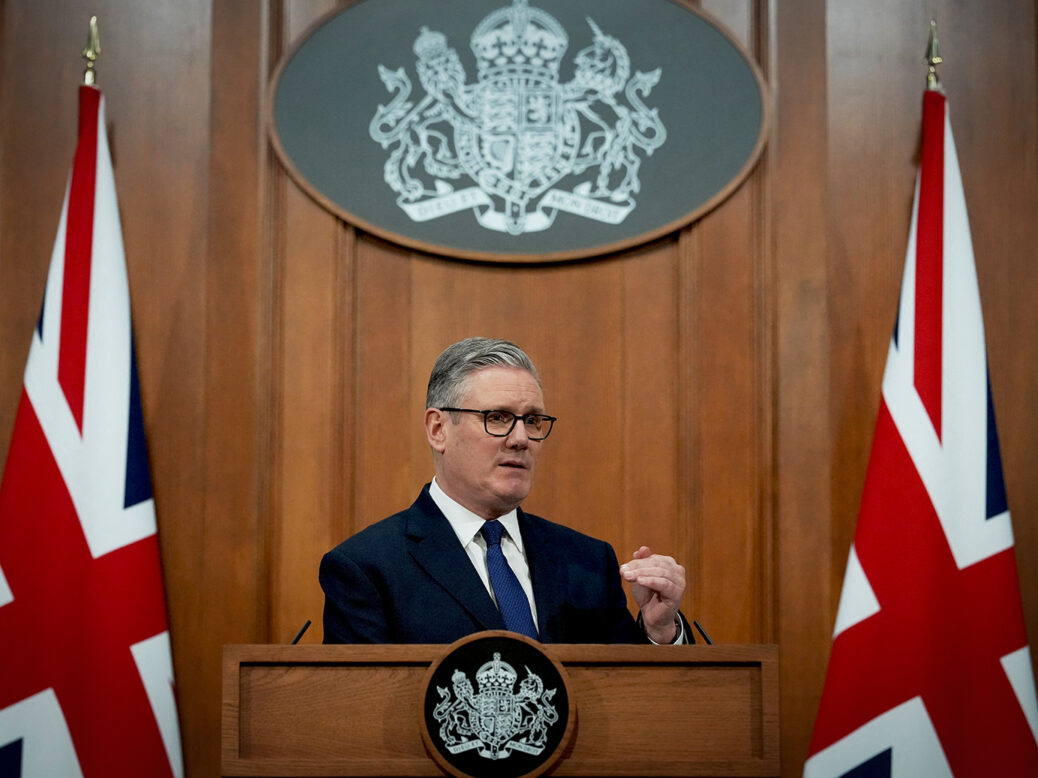
Keir Starmer delivered one of his updates on the Iran war this morning, in another press conference from Downing Street. But this one felt different.
The Prime Minister didn’t just give new information about the British effort – diplomatically and militarily – to restore freedom of navigation in the Middle East (a task that he underlined “will not be easy”), nor did he just repeat his important refrain that “this is not our war” and that the UK “will not be dragged” into it. He did something many of his colleagues had lost hope he was capable of. He stepped back and made a wider argument about where the country is going, telling the country how he intends to grow out of this crisis.
“It is the job of government to meet these moments, not just with immediate action but also with clarity about our direction,” he said. “That’s what I remember about the 1970s, when my family could not pay every bill. We struggled through the energy shocks and price rises of that decade. But we always believed in the end that Britain would secure a better future for us. And I think that’s what’s been lacking in the crises of recent years.
“I am not prepared to ask the British people, once again to go through a crisis, come out of it and say ‘business as usual’ – back to the status quo. So – on our economy, on our energy and on our defence – this time will be different. We will make Britain a fairer and more secure country because that hope is what is needed as the country comes together and because how we emerge from this crisis will define us for a generation.”

Every leadership contender who has been circling – Wes Streeting, Andy Burnham, Angela Rayner – has converged on essentially the same diagnosis of Labour’s, and specifically Starmer’s, problem since entering government: that he hasn’t been able to articulate what Britain after five or ten years of his government will or should look like, where the sunlit uplands are that Labour is working towards, and what principles are underpinning that mission. Today he delivered a riposte to that, linking his response to the immediate crisis in Iran with that bigger argument: that the Labour wants the UK to grow out of this crisis into a “fairer and more secure country”.
Of course, the vision is, essentially, Ed Miliband’s vision, but Starmer has embraced it as his own and the speech itself was “all KS”, one insider says. “We’re taking back control of our energy security, by investing in clean British energy,” Starmer declared. “Because that is the only way we get your bills off the rollercoaster that is controlled by Putin and the Iranian regime. And frankly, I am sick and tired of your energy bills fluctuating up and down because we are on the international market, when if we took control of our energy and had home grown renewables, we could stabilise your bills.”
The Iran crisis will continue to pose huge challenges for the British government and the British public, of course. But out of this crisis, Starmer is not only embracing the foreign affairs aspect that comes most naturally to him, but seems to be building that into the domestic vision and argument that has so often been lacking in his premiership to date.
[Further reading: Trump’s dead-end war]
Content from our partners


Related

Join the debate
Subscribe here to commentThen he needs to work on his pronouns. ‘WE’ can stabilise ‘YOUR’ bills builds in exactly the gap between the governing and the governed that Labour’s mission should be to close, and that populists exploit. ‘We’re in this together’ is very different from ‘I’ feel ‘your’ pain.
April Fool.